Our collection of original guitars undergoes periodically restoration, according to historical and scientific methods from master luthiers, expert in 18th and 19th century lutherie.
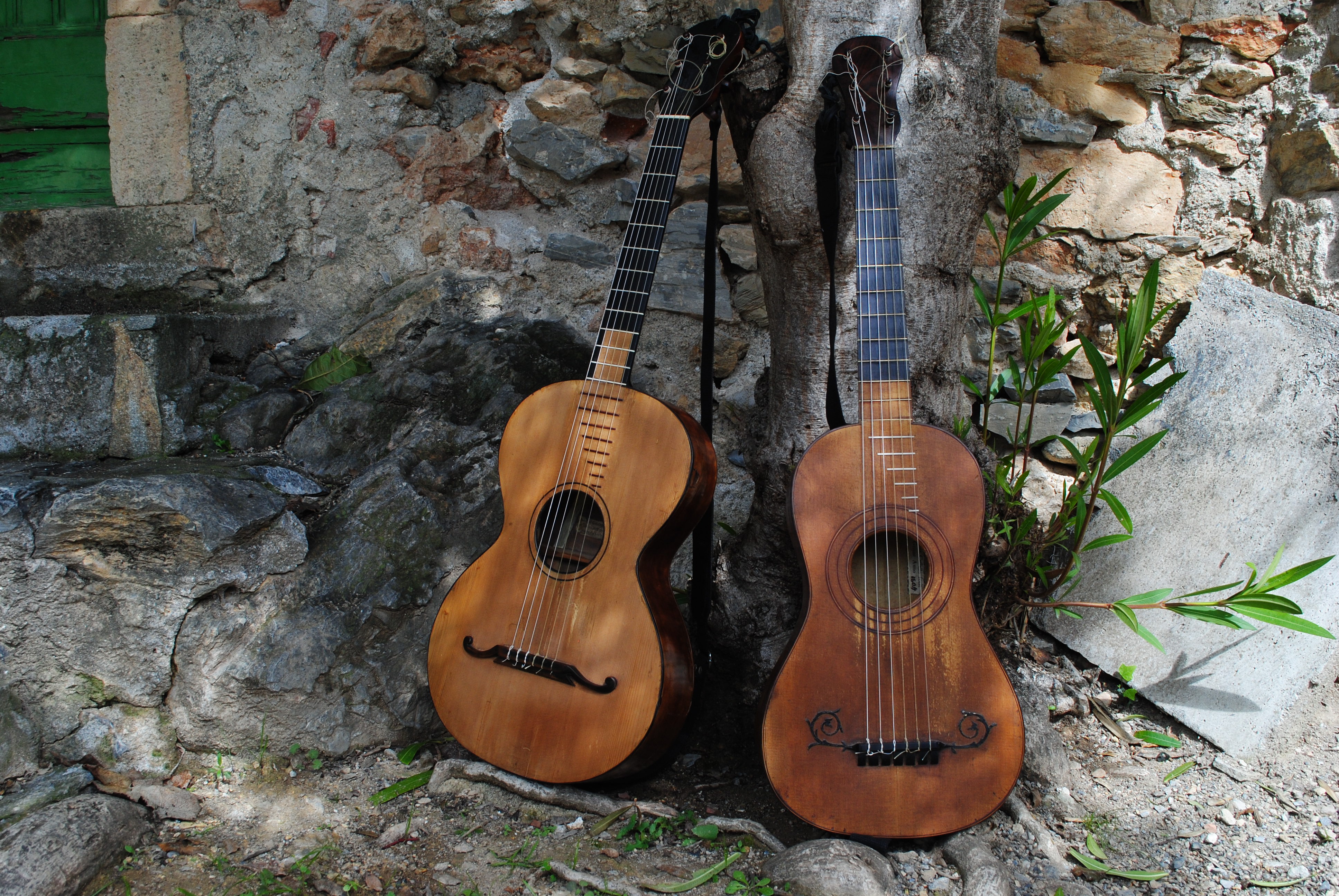


Guitar “Paulus Caftello fecit / Genuæ Anno 1804”
This instrument, found in the town of Alassio (IT), is an organological unicum by Paolo Castello, of one of the four luthiers active in Genoa (IT) during the second half of the 1700s: Filippo Cordano, Bernanrdo Calcagno, Bernardo Pizzorno and precisely the “Castellos”, a long generation of luthiers, who had their workshop downtown Genoa (IT), in the district called La Maddalena. Paolo Castello, in fact, is a celebrated luthier for his late-Baroque violins and violas. The Guitar of 1804 is an instrument that exhibits transition characteristics from Baroque to Classical form.

Guitar “Gaetano Guadagnini fece / in Torino nell’anno 1836 / in Piazza S. Carlo”
The guitar with cartouche of 1836 is representative of one of the most important workshops in the history of guitar making. The Guadagnini family, whose progenitor Lorenzo (1695-1750) worked as a luthier in Brescia, settled in Turin during the middle of the 1700s. Regarding the construction of guitars, the most famous ‘Guadagninis’ are Carlo (1768-1816) and his son Gaetano (1805-1852). Gaetano Guadagnini experimented new features by widening the body and accentuating body-sides curvature. The 1836 instrument has a rounded violin-like soundboard and bottom deck and shaped transverse chains. Gaetano’s guitars inspired the transalpine lutherie.
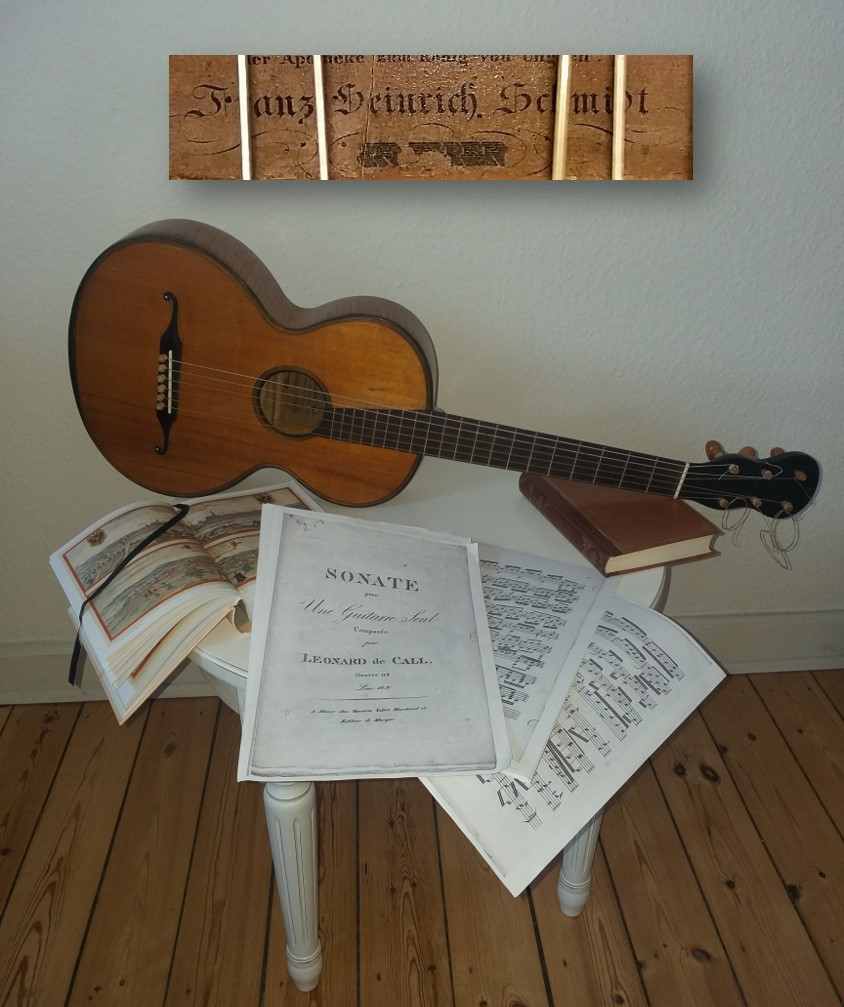
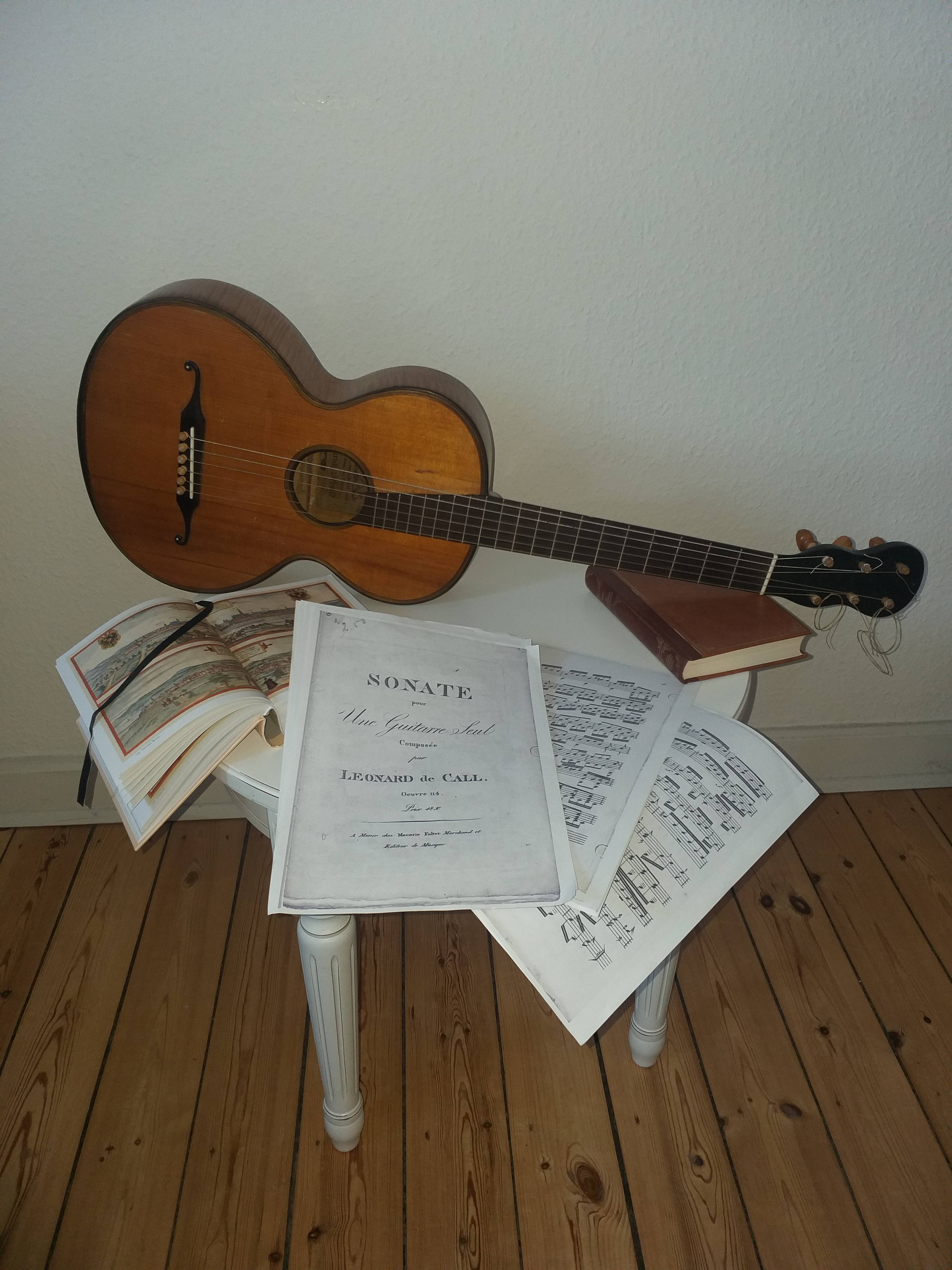
Terz-guitar “Franz Heinrich Schmidt / Rothenthumstraße Wien” c. 1848
The terz-guitar (It: chitarra terzina; Ge: Terz-Gitarre) was a smaller instrument than the normal guitar. It was intended to perform parts in a high register, especially for ensemble music. The first compositions dedicated to the terz-guitar are dated between 1807 and 1808 thanks to the South-Tyrolean composer Leonhard von Call (1767-1815).
Franz Heinrich Schmidt was not a luthier but a musical instruments seller, who worked as manager of an important shop in Rothenthumstraße in Vienna (AT). Schmidt covered the Viennese demand of guitars by importing instruments from Bohemia and Moravia, from the Vogtlandkreis in Saxony and from Budapest. Although structurally attributable to the Germanic area, the exact origin of this ‘Terz-Gitarre’ is uncertain, except that it crossed the streets of the Austrian capital during the riots of 1848, a period in which Schmidt was fully active in Vienna.

Guitar “J. N. Gade instrumentmager / boer / Borgergaden No. 197 / Kjöbenhavn” c. 1816
Jens Nielsen Gade can be considered the greatest luthier from the Scandinavian tradition and Danish school. The first sources about the Gade family in København (Copenhagen, DK) are attested during 1787 thanks to the registry (kirkebog) of the Trinitatis Kirke in the occasion of the wedding between the brewer Niels Jensen and the young Maren Mogensdatter. In 1788, their son Jens is baptized, while in 1790 Søren’s baptism is celebrated. One year later (1791), the documents attest that Niels Jensen Gade is born in Zealand (fød i Sjiland). This is the first time that the name “Gade” is mentioned in the church registry. According to the cadastral registry of Copenhagen, the Gade family lived in the “indre by” (inner city) of København (at that time: Kjöbenhavn) in Borgergade. In the years between 1794 and 1801, the municipality census listed a “høker” (hawker) Niels Jensen Gade in Borgergade 196. The property in Borgergade No. 196 was attributed to Niels Jensen Gade on the April 1797 and it remained in his name until his death in 1812. However, in 1806 new cadastral numbers were introduced. Thus, the address changed into Borgergade No. 197.
This instrument from 1816, authenticated by Kenneth Brøgger (the foremost specialist of historical Danish guitars) is a masterpiece of craftsmanship, where J.N. Gade put great attention to details, beautiful neck, floreal features typical of 19th century lutherie and ivory frets.
 Duo Noli-Soattin